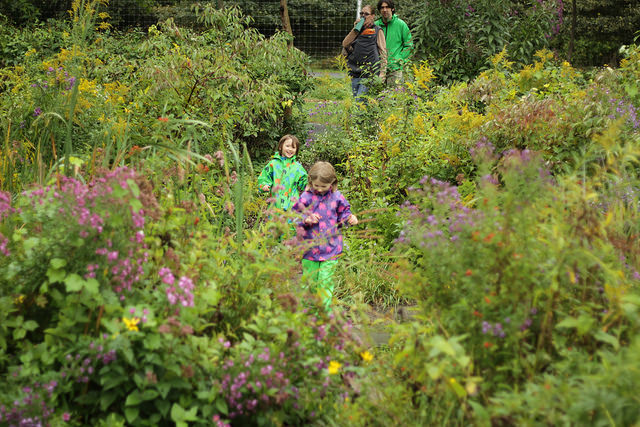
In 2025, ICG embarked on a process to draft an organizational IDEA Statement. Developed by a staff and board committee, our IDEA Statement charts a shared vision for IDEA at ICG, articulates the values and beliefs driving our IDEA work, and communicates our current IDEA priorities. It is intended to be a living document that is continually revisited, including through ICG’s upcoming strategic planning process.
Overview
Why IDEA at ICG
Ithaca Children’s Garden is committed to inclusion, diversity, equity, and accessibility because these values are core to realizing our vision that every child has the basic human right to play, learn, and grow outdoors.
For too long, children’s access to nature and free play has been governed by their race, class, gender, ability, zip code, and more. Racism, colonialism, economic injustice, ableism, and other systems of oppression collude to make green spaces inaccessible, unwelcome, and unsafe, particularly for Black, Brown, and Indigenous children. And in an increasingly unsafe world for LGBTQ+ children, there is a need for safe, affirming spaces where children can grow and play just as they are.
We will only achieve our mission to connect children to nature to create a more beautiful, resilient, and just world when we ensure that every child can feel at home at the Garden. This requires that we actively, affirmatively, and intentionally prioritize inclusion, diversity, equity, and accessibility in all that we do.
Our Values and Beliefs
- Belonging: We aspire that every child – especially those who have been historically excluded from access to nature and free play – feel seen, heard, accepted, and respected in the Garden.
- Justice: No matter who they are, every child deserves to access the benefits of playing, growing, and connecting with nature.
- Multiculturalism: We strive for ICG to better reflect our diverse communities over time. We seek to dismantle multiple systems of oppression, including racism, ableism, homophobia, and transphobia, in our spheres of influence and the ways in which we do our work.
- Safety: We aspire to create an environment where all children can feel safe, be themselves, and be free from harm.
Current IDEA Priorities
These five priorities reflect areas ICG staff identified as needing more attention and work to improve inclusion, diversity, equity, and accessibility within the organization. While work is ongoing across all priorities, in 2026, we are particularly focused on accessibility and disability inclusion.
- Accessibility and Disability Inclusion: Work to make ICG as welcoming and accessible as possible to Disabled children and families* by continually improving our physical and digital spaces, updating our accommodations policy, and exploring how to increase access to transportation to ICG.
- BIPOC and Immigrant Inclusion: Increase participation from underserved communities by doing more intentional outreach and relationship-building, aligning our programming with the needs of families, working to ensure our scholarships reach those most in need, and celebrating cultural diversity.
- LGBTQ+ Inclusion: Continue to ensure that ICG is welcoming to LGBTQ+ children and families by communicating our values and expectations to ICG’s community, expanding outreach, and regularly seeking to evaluate and improve our policies and practices.
- Hiring, Training, and Professional Development: Support staff by 1) strengthening our professional education and training, policies, benefits, and more; 2) building a culture where all feel welcomed and a sense of belonging; and 3) defining how we can become an anti-racist organization.
- Community Engagement and Communication: Deepen engagement with our communities about our IDEA values, beliefs, and priorities by fostering open dialogue, listening to their needs to inform our work, and sharing our commitments with transparency, accountability, and clarity as we strive to continuously improve.
*We strive to use language that is inclusive, respectful, and reflective of everyone we welcome to the Garden. In this Statement, we use identity-first language (e.g., Disabled children), guided by input from members of our local disability community and insights from the wider disability justice movement. We also recognize that language preferences vary, and many people prefer person-first language (e.g., children with disabilities). Both approaches are valid, and we respect and honor individual preferences.